
Increasing Visibility through GEO

Reto Hohenberger
Digital Experience Expert
An initial answer to leveraging the opportunities of AI development focuses on the digital storefront: the website. AI search and chatbots are changing classic search behavior via search engines. According to ChatGPT, 15–20% of information queries are currently handled via AI tools. This shift is not a classic substitution, as the underlying search logics are also changing. With smart extensions, increased visibility becomes measurably possible.
Why to increase your visibility through GEO
Digital visibility has long been linked to classic search engines such as Google. For years, organic rankings, technical optimization, and the right keyword strategy formed the basis for content being found and reaching the right target groups, even in B2B environments.
With the rise of generative AI and dialog-based search systems, the playing field is expanding significantly. Platforms such as ChatGPT, Perplexity, or the new Google Search integrate language models that not only display information but actively process, evaluate, and place it into new contexts.
This development changes how content is read and discovered. Companies increasingly ask how to further develop their SEO strategy so that it remains visible and relevant in AI-based environments.
This is not about a complete realignment, but targeted extensions: structuring content more clearly, making contexts easier to understand, and preparing trustworthy information so that it is also comprehensible for machines.
AI Changes SEO – but Does Not Replace It
Search engines no longer just deliver lists, but answers. Systems such as Google SGE, ChatGPT, or Perplexity combine web search with generative models, offering users direct, often context-rich access to information. Clicks on organic links are becoming less frequent, as many questions are already answered on the results page.
For companies, this raises a simple but crucial question: How do you remain visible when search results are increasingly generated by AI?
Classic SEO remains relevant. In addition, targeted measures can ensure that content becomes understandable and discoverable for language models. Anyone still planning to "just" rank in the top 10 is thinking too narrowly. The new paradigm is to appear in AI overviews or to be cited as a source.
SEO Meets AI: What Lies Behind LLMO, GEO & Co.
With the increasing integration of language models into search systems, new requirements for content are emerging—and with them new terms. Two are currently in particular focus: LLMO and GEO.
LLMO (Large Language Model Optimization) describes the targeted optimization of content so that it can be meaningfully interpreted by language models such as GPT, Claude, or Gemini and ideally used as a source. In addition to the right keywords, clarity of structure, comprehensible context, and reliable information are key. Content should answer specific questions, be clearly structured, and easily processed by machines —for example through subheadings, structured data, or references.
GEO (Generative Engine Optimization) goes one step further. It considers not only the model itself, but the entire search system based on generative AI, such as Google SGE or Perplexity. GEO asks: How must content be structured to remain visible within these systems as a whole? Semantic linking, structured data, and formats preferred by AI play a decisive role.
New Reality: AI Overviews and Decoupled Visibility
This shift is particularly evident at Google itself. With the new AI Overviews (AIO), the search results page is changing dramatically. Instead of blue links, Google presents an AI-generated answer, often including recommendations, citations, and dynamic snippets. Organic results are pushed further down, and the traditional SEO click logic is destabilized.
This has two major effects:
- Loss of click-through rates on search result pages, as many users remain in the overview.
- A new visibility logic: those who are referenced gain reach without being "ranked" in the traditional sense.
For companies, this means a shift in focus: from rankings to references. Visibility no longer arises solely from SEO tactics, but from the structural and semantic quality of content. The demands for precision, clarity, and trustworthiness increase noticeably.
What Can Be Optimized?
Especially in B2B environments with complex topics, high information needs, and long purchasing processes, there are numerous opportunities to prepare content so that it becomes more readable and usable for large language models.
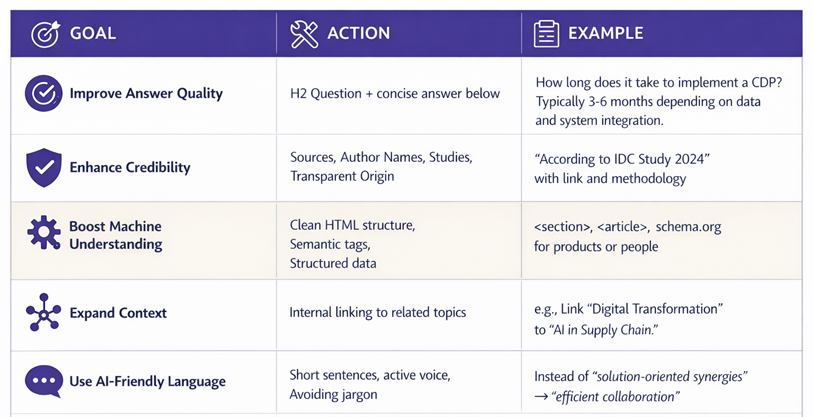
Figure 1: Content Optimization Opportunities; author's own illustration; created with Microsoft Copilot, based on the author's own content.
What Is Possible — and Where Are the Current Limits?
The integration of generative AI into search opens new opportunities, but it also shifts the rules of the game. Visibility is no longer created solely through placements in traditional search results, but through contextual mentions, citations, or references in AI-generated answers. What initially sounds like more reach also brings new challenges.
Visibility Is Becoming Decoupled
A central issue: between publishing content and its potential use by language models lies an unclear time span — the so-called lead times. Language models such as GPT-5 or Gemini 2.5 rely on already indexed information that is often weeks or even months old. This means that even if content is current, high-quality, and optimized, it may take time before it is indexed or considered. For companies, this makes timely reactions more difficult and further decouples action from outcome.
Control Is Limited
There are also limitations at the control level. While in SEO one could usually optimize specifically for certain rankings or snippets, this precision is lacking in the AI context. There is no classic ranking anymore, no guaranteed positions on page one, but rather a dynamic selection based on relevance, clarity, context, and trust. Who appears where and when in an AI-generated answer is difficult to predict — and even harder to control.
Monitoring Becomes a Key Competency
In this uncertainty, monitoring becomes the strategic foundation. Companies should focus more strongly on the following questions:
- Which AI systems are crawling my content? Log analyses for crawlers (e.g., GPTBot, Google-Extended, PerplexityBot) help us understand whether — and how — content is being ingested.
- Which sources are ChatGPT, Perplexity, or Google AIO currently citing in my topic area? Regular spot checks and prompt analyses reveal whether your own content is being referenced — and by whom.
- Which traffic streams are coming via AI platforms? Even if ChatGPT traffic isn't directly reported in common web analytics tools, UTM parameters, referrer analysis, or bot behavior can provide valuable clues.
- How is visibility changing due to Google AI Overviews (AIO)? AIOs in particular are pushing down traditional search results. Close SERP monitoring helps detect changes early.
Monitoring is not a substitute for strategy — but without monitoring, we are flying blind. Only through data do we gain the necessary visibility to optimize content effectively.
Quality Beats Speed
Despite all automation, one thing remains true: those who produce content only for machines lose. AI systems do not just analyze keywords or backlinks; they also favor patterns that indicate structure, context, and relevance. Quickly generated texts without recognizable depth often remain invisible. What truly counts are clear argumentation, traceable sources, and content that is well embedded — because it is more understandable and usable for both people and models.
Conclusion: More Visibility through Smart Extensions
The combination of traditional SEO with AI-supported optimization is not a radical disruption, but a logical next step. For companies, this offers the opportunity to prepare content not only for people, but also for machines — and thus become visible in a new digital space.
The key principle is simple: not replacing, but complementing. Classic SEO remains the foundation, while LLMO, GEO, and AIO serve as extensions. Those who begin today to strategically connect these building blocks lay the foundation for sustainable visibility in an increasingly AI-shaped search landscape.
Concrete Benefits of AI Development for Swiss Companies
In the coming quarter, our Business Swiss experts will shed light on the opportunities of AI development. In which areas do companies and SMEs effectively benefit? Where are smaller investments worthwhile to achieve measurable results? Monthly insights prepare us for exciting discussions at the next event. Join us.
About the author
Reto Hohenberger
Digital Experience Expert
Our digital expert Reto Hohenberger experimented with simple product catalogs in B2B e-commerce back in 2003. He leverages his years of experience in digital development to guide and empower people and organizations on their digital journey.